

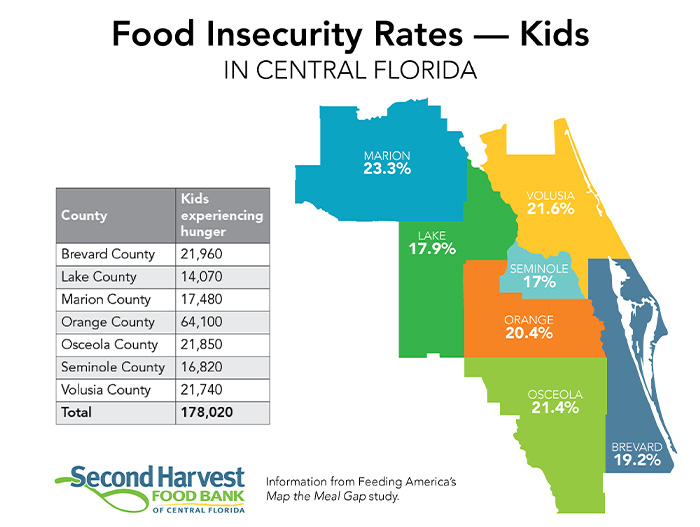
Second Harvest Food Bank of Central Florida. (2026, August 11). Map the Meal Gap Report – Second Harvest Food Bank of Central Florida. https://feedhopenow.org/our-work/hunger-in-central-florida/map-the-meal-gap-report/
November Research Spotlight:
Giving Neighbors a Seat at the Table
Focus Area: Pediatric Food Insecurity Screening
Resource Snapshot
Best For: | Organizations Conducting SDOH Screening |
Time to Read Article | 15 Minutes |
Link |
Throughout America, 1 in 5 households with children are experiencing food insecurity. 1 In Central Florida alone, the number of children experiencing food insecurity increased from 1 in 6 (2023) to 1 in 5 in just one year. Food insecurity (FI) has the power to hold a child back from their full potential and can create barriers to a happy and healthy future. It leads to poor academic performance, developmental challenges, and impacted health status. This is the reality of over 178,000 children across the seven counties we serve grapple with. 2
Though FI screening has been around for over 25 years, its focus on children is an idea that just recently gained traction. The American Academy of Pediatrics was the first to recommend FI screening in pediatric settings, and they reaffirmed this stance in 2021. With a recent change comes emerging research, focused on establishing best practices for hospital systems to better detect this social determinant of health and consider whole-person circumstances to identify a proper course of action. This month’s resource, Food for Thought: A Qualitative Evaluation of Caregiver Preferences for Food Insecurity Screening and Resource Referral, explores key points of this practice through the eyes of neighbors. As we move forward in making resource referrals for families with children experiencing food insecurity screenings, we must consider the process from the perspective of our neighbors to strengthen this initiative. After all, we cannot best serve them without their insight.
Key Finding #1: Factors Impacting Caregiver Comfort about Screening
- While comfortability varied by caregiver, screening was typically viewed as helpful and sometimes even necessary to identify the problem and gain access to resources.
- Food insecurity is a stigmatized social reality, and caregivers that perceived screening negatively most often feared negative consequences or judgement.
- Technology-based screening was more favorable compared to verbally conducted screening. Over 80% of all participants preferred screening via tablet, and this preference is reiterated in the caregiver recommendations.
Key Finding #2: Factors Affecting Resource Acceptance
- Caregivers often attributed refusal of resources to the belief that their situation is not enough to warrant additional resource use or they would be taking resources from other families.
- Negative previous experiences attempting to access social resources or insufficient resources to meet the needs of the family contributed to a lack of trust in resources.
- Many caregivers noted other responsibilities taking precedent created a barrier to engaging with resources.
Key Finding #3: Caregiver Insights for Resource Referrals
- Several caregivers agreed that technology-driven screening and referral systems may lead to increased accuracy of screening and referral acceptance.
- General distribution of food access resources without the need for screening helps connect families to resources before the need for a hospital visit. Varying modes of advertisement and frequent access to information serve as reminders and may better equip families with the knowledge that these resources are readily available.
- Caregivers shared that resources were not geographically convenient and urge referrers to consider a family’s location when sharing resources.
Recommendations: Putting Theories into Practice
- Consider the language used when introducing the screening and promote a safe environment for this sensitive topic. If possible, consider switching to a written or electronic method of screening to encourage privacy.
- Tailor resources to a family’s local community and consider eligibility requirements for resources before a referral is made.
- Educate on the underutilization of resources to combat the lower perception of need compared to other families.
- Send out electronic-based resource lists in conjunction with or instead of paper lists to ensure caregivers always have access to the resource.
Sources
1 Feeding America. (2022). Facts about child hunger in America. Feedingamerica.Org. https://www.feedingamerica.org/hunger-in-america/child-hunger-facts
2 Second Harvest Food Bank of Central Florida (2025, August 11). Map the Meal Gap Report. https://feedhopenow.org/our-work/hunger-in-central-florida/map-the-meal-gap-report/
This post is based on the following article:
Cullen, D., Attridge, M., & Fein, J. A. (2020_. Food for Thought: A Qualitative Evaluation of Caregiver Preferences for Food Insecurity Screening and Resource Referral. Academic Pediatrics, 20(8), 1157-1162.
https://doi.org./10.1016/j.acap.2020.04.006